
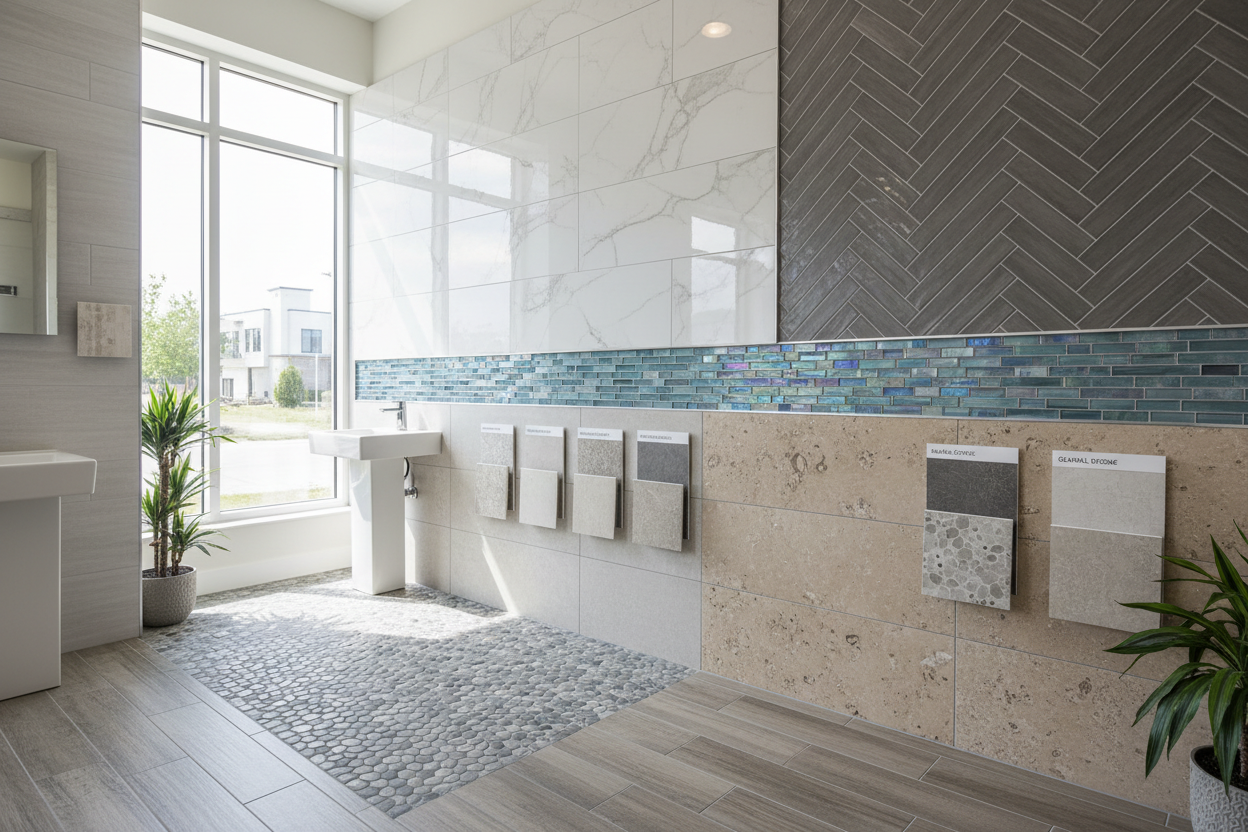
Quick Answer: What Are the Main Types of Bathroom Tile?
The main types of bathroom tile are ceramic, porcelain, natural stone, glass, mosaic, cement, and pebble tile. Porcelain is the most durable and water-resistant for floors and wet zones. Ceramic is the most budget-friendly for walls. Natural stone — marble, travertine, slate, quartzite — delivers the highest-end look and lasting home value. Glass and mosaic tiles work best as accents, shower niches, or feature elements. Pebble tile is the top choice for organic, spa-inspired shower walls and floors. The right choice depends on your specific location (floor, wall, or shower), budget, maintenance tolerance, and design goals.
Walk into any home improvement store and the tile aisle alone is overwhelming — dozens of materials, hundreds of finishes, thousands of sizes and patterns, all claiming to be exactly what your bathroom needs. It's a lot. And the stakes feel high because bathroom tile is a 10–30 year decision. Choose well and your bathroom becomes a daily pleasure. Choose poorly and you're looking at a surface that underperforms and doesn't look right — for a very long time.
Here's the truth most tile guides miss: the majority of tile shopping mistakes don't happen because someone chose a "bad" tile. They happen because someone chose the right tile for the wrong place. A beautiful polished marble that looks stunning on a feature wall becomes a maintenance nightmare on a shower floor. A matte stone that's perfect for a powder room floor isn't frost-rated for an outdoor bathroom in Minnesota. A budget ceramic that works brilliantly on a half-bath wall doesn't have the density needed for a high-traffic master bathroom floor.
This guide fixes that. We'll walk you through every major type of bathroom tile — what it is, what it costs, where it performs, and where it doesn't — plus a breakdown of finishes, sizes, and a room-by-room decision guide. By the end, you'll know exactly which tile fits your space, budget, and life.
What's in This Guide
- How to Think About Choosing Bathroom Tile
- Ceramic Tile
- Porcelain Tile
- Natural Stone Tile
- Pebble & River Rock Tile
- Glass Tile
- Mosaic Tile
- Cement & Encaustic Tile
- Bathroom Tile Finishes Explained
- Tile Sizes & Formats: What to Use Where
- Room-by-Room Tile Selection Guide
- Real Cost Breakdown (2026)
- Frequently Asked Questions
- Conclusion
1. How to Think About Choosing Bathroom Tile
Before you look at a single tile, answer these four questions. They'll filter your choices faster than any trend report.
Question 1: Where Is It Going?
Floor tile and wall tile are not interchangeable. Floor tiles must be slip-resistant and rated for foot traffic. Wall tiles need to adhere to a vertical surface without bearing load. Shower tiles must be water-rated and compatible with proper waterproofing systems. Outdoor tiles need frost resistance in most American climates. Location determines technical requirements — and those requirements narrow your choices significantly before aesthetics even enter the picture.
Question 2: How Much Traffic Will It Handle?
The Porcelain Enamel Institute (PEI) rates tile hardness on a scale from 1 (decorative only) to 5 (commercial heavy duty). For bathroom floors in an average home, PEI 3 is the minimum. For high-traffic master or family bathrooms, PEI 4 gives meaningful durability margin. For wall tile, PEI rating is largely irrelevant — the tile doesn't face foot traffic.
Question 3: What's Your Honest Maintenance Comfort Level?
Natural stone is extraordinary, but it requires annual sealing, pH-neutral-only cleaners, and prompt attention to spills. Porcelain requires almost none of that. If your household cleaning routine is quick and convenient, match your tile to that reality — or you'll have a beautiful surface that looks neglected within a year.
Question 4: What's the All-In Budget?
Never price just the tile. The full picture includes: tile material + installation labor + thinset + grout + waterproofing membrane (wet areas) + sealer + trim pieces. These additional costs typically add 40–80% on top of tile material price alone. A tile at $8 per square foot may realistically cost $18–25 per square foot once everything is accounted for. If you're still defining your budget, our guide to how to choose bathroom tiles walks through the full planning process.
📊 Market Reality: According to HomeAdvisor's 2025 True Cost Guide, the average American homeowner spends $900–$2,500 to tile a standard bathroom, and $1,500–$6,000+ for a full master bathroom renovation with premium tile. The NKBA's 2024 Design Trends Report found that 68% of bathroom remodelers prioritized creating a "spa-like" environment — driving strong demand for natural stone, large-format porcelain, pebble tile, and decorative mosaic categories.
2. Ceramic Tile
Ceramic Tile
Ceramic tile is made from natural clay, shaped, glazed on the surface, and fired in a kiln. The glaze is waterproof; the clay body beneath is not — which is why ceramic works well on bathroom walls but requires more careful consideration for high-moisture floors. It comes in virtually every color, pattern, size, and finish imaginable, and it's been the backbone of American bathroom design for decades because it delivers real performance at accessible prices with genuinely DIY-friendly installation.
Ceramic is softer than porcelain, which makes it easier to cut — a real advantage for complex shower layouts, plumbing fixture cutouts, and detailed decorative work.
Pros
- Most affordable tile option available
- Easiest to cut — highly DIY friendly
- Enormous variety of colors, styles, patterns
- Glazed surface is waterproof on walls
- Long lifespan (30–50 years) with proper installation
Cons
- Less dense than porcelain — chips more easily
- Not ideal for very high-traffic bathroom floors
- Cannot be used outdoors in freeze-thaw climates
- Color only in surface glaze — chips reveal white clay body
✔ Expert Pick: Use ceramic for bathroom walls, half-bath floors, and shower walls where aesthetics matter and traffic is moderate. For high-traffic master bathroom floors or shower zones, step up to porcelain. If you're weighing the two directly, read our ceramic vs. porcelain tile comparison for a full breakdown.
3. Porcelain Tile
Porcelain Tile
Porcelain is a type of ceramic fired at higher temperatures (around 1,220°C) from finer, denser clay. The result is a tile that is harder, denser, and far less porous than standard ceramic. Porcelain's water absorption rate falls below 0.5% — essentially impervious to moisture — making it the most practical all-around choice for wet bathroom environments, high-traffic floors, and outdoor applications in most American climates.
In 2026, large-format porcelain panels (24"×48" and above) are defining modern bathroom design — creating near-seamless surfaces with minimal grout lines. Advanced digital printing allows porcelain to convincingly replicate marble, travertine, slate, and wood, giving homeowners premium aesthetics without the ongoing maintenance of the real material.
Pros
- Extremely durable — PEI 4–5 rated for floors
- Water absorption below 0.5% — ideal for all wet zones
- Frost-resistant — suitable for outdoor bathrooms
- Color goes all the way through — chips far less visible
- Available in very large formats for seamless, modern aesthetics
- Convincingly mimics stone, wood, and concrete finishes
Cons
- More expensive than ceramic upfront
- Harder to cut — wet saw required, professional recommended
- Can feel cold underfoot (radiant heating helps)
- Heavier than ceramic — substrate must support the weight
- Polished porcelain is dangerously slippery on wet floors
✔ Expert Pick: Porcelain is the safest all-purpose bathroom tile. When in doubt between ceramic and porcelain for any wet or floor application, always choose porcelain. For everything you need to know about this material, see our complete porcelain tiles guide.
📊 Industry Data: According to the Tile Council of North America (TCNA), porcelain tile's share of the US residential tile market has grown consistently year-over-year, driven by digital printing advances that make it visually competitive with premium natural materials at a fraction of the maintenance cost.
4. Natural Stone Tile
Natural Stone Tile — Marble, Travertine, Slate, Quartzite, Granite & More
Natural stone tile is quarried directly from the earth — each tile is a unique product of geology with no two pieces exactly alike. Marble, travertine, slate, quartzite, granite, limestone, and basalt are the most common types in American bathrooms. The organic variation, authentic depth, and timeless beauty of real stone is genuinely irreplaceable — which is why premium tile manufacturers spend enormous resources trying to imitate it in porcelain.
The critical decision with natural stone isn't which stone looks best — it's which stone performs correctly in your specific application. Stone types vary dramatically in hardness, porosity, and suitability for wet environments. Getting this match wrong is one of the most expensive renovation mistakes a homeowner can make. Our in-depth guide to natural stone wall tiles — costs, pros and cons covers every stone type in detail.
Pros
- Unmatched authentic beauty — every tile is genuinely unique
- Adds real, measurable home resale value
- Can last 50–100+ years with proper care
- Eco-friendly — no synthetic materials, no VOCs
- Develops attractive character and patina with age
- Excellent thermal conductor — ideal with radiant heating
Cons
- Most expensive tile category overall
- Most types require annual sealing in wet zones
- pH-neutral cleaners only — standard sprays cause damage
- Professional installation strongly recommended
- Very difficult to match tiles from a different production lot
Choosing the Right Stone for Your Bathroom
| Stone Type | Hardness (Mohs) | Porosity | Best Bathroom Use | Maintenance |
|---|---|---|---|---|
| Marble | 3–4 | Medium–High | Feature walls, vanity backsplash, shower (honed finish only) | High — seal annually |
| Travertine | 3–4 | High | Bathroom walls, shower surround (filled & sealed) | High — seal annually |
| Slate | 4–5 | Medium | Feature walls, floors, outdoor walls | Medium — seal every 2 yrs |
| Limestone | 3–4 | High | Dry feature walls and sheltered applications only | High — seal regularly |
| Granite | 6–7 | Very Low | Any bathroom wall or floor, kitchen backsplash | Low — seal every 3–5 yrs |
| Quartzite | 7+ | Low | Shower walls, floors, any wet zone | Low — top performer in wet areas |
| Basalt | 6–7 | Low–Med | Modern bathrooms, shower walls, spa spaces | Low–Medium |
✔ Expert Pick: For shower walls and wet applications, quartzite and granite are the top-performing natural stones. For feature walls where beauty is the priority, marble and travertine are extraordinary. For more on how stone performs specifically in bathroom walls, read our guide on stone walls in bathrooms — pros, cons, and mistakes to avoid.
5. Pebble & River Rock Tile
Pebble & River Rock Tile
Natural pebble tile — river rock mosaics mounted on mesh backing sheets — is one of the most distinctive choices available for bathroom walls and shower floors. These are actual stones, smoothed naturally by centuries of river water flow, assembled on sheets that install just like standard tile. The result is an organic, three-dimensional surface that brings genuine nature into your bathroom in a way no manufactured tile can replicate.
In 2026, pebble tile is growing strongly as part of the biophilic design movement — the intentional incorporation of natural elements into home environments. Used on shower walls, accent walls, or shower floors, it creates an immersive spa experience that transforms the daily shower into something genuinely restorative. For a full look at options and inspiration, see our 2026 pebble tile buyer's guide.
There are two primary styles. Round tumbled pebbles give the classic massage-like tactile texture — three-dimensional, deeply organic, with more grout lines to maintain. Flat-sliced pebbles cut horizontally through each stone to reveal its interior, offering the same natural beauty with a smoother surface, shallower grout lines, and significantly easier cleaning. If you want the look with less maintenance, flat-sliced is the smarter choice.
Pros
- Unmatched organic, spa-like aesthetic
- Natural slip resistance on shower floors
- Mesh backing simplifies installation significantly
- Every sheet is genuinely unique
- Works beautifully on both walls and floors
- Natural material — VOC-free, eco-conscious
Cons
- Round tumbled style has more grout lines to maintain
- Requires sealing before and after grouting
- Annual re-sealing needed in wet shower zones
- More visible grout lines than large-format tile
✔ Expert Pick: Use flat-sliced pebble tile for shower walls and floors when easy maintenance matters. Use round tumbled pebble when you want maximum tactile texture and the full immersive spa experience. For shower floor specifics, our guide to pebble tile shower floors covers everything you need to know before buying. Browse the full range at Pebble Tile Shop.
6. Glass Tile
Glass Tile
Glass tile is completely non-porous and 100% waterproof — it cannot absorb moisture, making it inherently resistant to mold and mildew. Its most distinctive quality is reflectivity: glass bounces light around a space, making small bathrooms feel significantly brighter and more open. It comes in an enormous range of colors, opacities, and surface treatments — from translucent sea-glass effects to metallic-coated and iridescent finishes.
Glass tile is most effective as an accent — in shower niches, as a decorative band on shower walls, as a vanity backsplash, or as a border framing another tile material. Even a single horizontal strip of glass tile within a porcelain or stone shower creates a jewel-like detail at a relatively modest cost. For shower wall applications specifically, read our guide to the best glass tile for shower walls.
Pros
- 100% non-porous — zero sealing required
- Reflects light — visually expands small bathrooms
- Enormous color and finish variety
- Completely mold and mildew resistant
- Timeless, high-end appearance
Cons
- Most expensive tile category per square foot
- Very difficult to cut precisely — professional install recommended
- Scratches more easily than porcelain
- Shows water spots and fingerprints readily
- Slippery on floors — not suitable for bathroom floors
- Adhesive visible through tile — must be applied with zero trowel marks
⚠ Important: Glass tile requires white thinset applied with a perfectly smooth, mark-free surface — any trowel texture shows through the translucent glass. This is the primary reason professional installation is strongly recommended beyond simple backsplash applications.
7. Mosaic Tile
Mosaic Tile
Mosaic tile is a format, not a material. It refers to small individual pieces — typically 2 inches or smaller — mounted on mesh backing sheets. Those pieces can be ceramic, porcelain, glass, natural stone, or pebble. The mesh format makes what would otherwise be an impossibly labor-intensive installation manageable for experienced installers and capable DIYers.
In 2026, mosaic tile is experiencing a real resurgence — particularly in shower floors, shower niches, and feature walls. Combining mosaic tiles with large-format field tiles is one of the most effective design moves in modern bathroom renovation: use large format for expansive wall coverage, then drop to a mosaic accent strip, niche lining, or shower floor feature to add texture and visual interest without overwhelming the space. Our guide to what mosaic tile is and how to use it goes deeper on types, patterns, and applications.
Pros
- Excellent slip resistance on shower floors — more grout joints means more grip
- Enormous creative flexibility across colors, materials, and patterns
- Ideal for curved surfaces and drain surrounds
- Available in porcelain, glass, stone, and pebble formats
- Creates complex decorative designs at accessible cost
Cons
- More grout lines mean more regular cleaning required
- Higher installation labor cost than large-format tile
- Grout joints can harbor mold without consistent maintenance
- Sheet alignment requires patience and skill
✔ Expert Pick: Mosaic tile is the best-performing format for shower floors — grout line density provides genuine slip resistance, and the small format naturally follows the slope toward the drain. Use as a niche accent or feature strip within larger field tiles on shower walls for maximum impact with minimal complexity.
8. Cement & Encaustic Tile
Cement & Encaustic Tile
Cement tiles are made from Portland cement, fine aggregate, and mineral pigments pressed under high pressure — not kiln-fired. Their colors and patterns penetrate through the full tile thickness, so they never "wear through" the way a surface glaze can. Handmade versions have beautiful natural color variation that makes every installation feel genuinely custom and one-of-a-kind.
Cement tiles are having a significant moment in 2026 bathroom design — particularly in powder rooms, feature walls, and lower-traffic bathroom floors where their distinctive geometric and artisan patterns create a bold statement. They're not suitable for continuous wet exposure like shower floors without a very rigorous sealing program, but in well-ventilated bathroom spaces they're genuinely beautiful.
Pros
- Distinctive handmade character — no two tiles exactly alike
- Pattern runs through full tile thickness — never wears away
- Wide range of geometric and artisan designs
- More sustainable than kiln-fired alternatives
- Develops attractive lived-in patina with age
Cons
- Very porous — requires thorough sealing before and after grouting
- Not suitable for continuous wet exposure without rigorous maintenance
- Requires pH-neutral cleaning products only
- Scratches more easily than porcelain or stone
- Must be re-sealed every 1–2 years
9. Bathroom Tile Finishes Explained
The finish of a tile determines how it looks, how safely it performs underfoot, and how easy it is to keep clean. This matters as much as material choice — and it's one of the most frequently overlooked decisions in tile selection.
Polished
High-gloss, mirror-like surface. Stunning on walls. Never use on bathroom floors — dangerously slippery when wet.
Honed
Smooth, matte or satin surface with no gloss. Safe for both floors and walls. The most versatile finish for any bathroom location.
Matte
Flat, non-reflective surface. Hides water spots and smudges beautifully. The top 2026 choice for bathroom floors.
Textured / Grip
Deliberately roughened for slip resistance. Best for shower floors and wet floor areas. Slightly harder to clean but significantly safer.
Tumbled
Stone edges and surface softened by tumbling — creates a naturally aged, weathered look. Provides natural slip resistance. Popular for pebble tile and travertine.
Brushed / Leathered
Surface treated to reveal natural texture while remaining relatively smooth. Hides fingerprints and watermarks well. Popular for granite and quartzite.
Glazed
High-shine ceramic coating. Bright and easy to wipe on walls. Always pair with a grip-rated version on floors for safety.
Split-Face
Stone split along natural cleavage planes for rough, dimensional texture. Dramatic on feature walls. Not suitable for any floor application.
⚠ Safety Rule: For any bathroom floor in a wet zone or shower, the tile must have a Dynamic Coefficient of Friction (DCOF) rating of 0.42 or higher — the ANSI A137.1 standard for wet areas. Always confirm this rating with your supplier before purchasing floor tile for any wet application. Polished and high-gloss finishes rarely meet this threshold.
10. Tile Sizes & Formats: What to Use Where
Format affects how your bathroom looks, how easy it is to clean, and how spacious it feels — not just the style. Here's how to use tile size strategically.
| Format | Common Sizes | Visual Effect | Best Application |
|---|---|---|---|
| Mosaic | 1"×1" to 2"×2" | Detailed, textural, artisan feel | Shower floors, accent features, niches |
| Mini / small format | 3"×3" to 4"×4" | Traditional, cottage-inspired | Shower floors, small bathroom floors |
| Subway / brick | 3"×6", 4"×8" | Classic, timeless, broadly versatile | Shower walls, bathroom walls, backsplashes |
| Mid format | 12"×12", 12"×24" | Balanced, clean, contemporary | Bathroom floors, shower walls, general use |
| Large format | 24"×24", 24"×48" | Modern, expansive, minimal grout lines | Bathroom floors, feature walls, large showers |
| XL / slab panel | 48"×48" and above | Seamless, luxury-hotel quality | Feature walls, luxury master bathrooms |
| Pebble sheets | 12"×12" mesh sheets | Organic, three-dimensional, nature-inspired | Shower floors and walls, spa-inspired spaces |
| Border / liner | 1"×12", 2"×12" | Decorative accent, clean visual break | Shower wall borders, tile transitions |
✔ Design Insight: Large-format tiles (24"×24" and above) make small bathrooms feel significantly larger by reducing the grout lines that visually fragment the surface. This is the single most effective technique professional bathroom designers use in compact spaces — and it works at budget and luxury price points equally well. For small shower spaces specifically, our shower tile ideas for small spaces guide covers this in depth.
11. Room-by-Room Tile Selection Guide
| Location | Best Material | Best Finish | Avoid |
|---|---|---|---|
| Shower floor | Mosaic, natural pebble tile, textured porcelain | Textured / grip-rated (DCOF 0.42+) | Polished stone, high-gloss tile, large-format slabs |
| Shower walls | Porcelain, ceramic, quartzite, honed marble, pebble tile | Matte, honed, or satin | Highly polished finishes, unrated porous stone without sealing |
| Bathroom floor | Porcelain, quartzite, textured ceramic, honed slate | Matte, honed, or textured | Polished marble, high-gloss ceramic, unsealed cement tile |
| Bathroom walls | Ceramic, porcelain, marble, travertine, glass accent | Glossy or matte (no grip rating needed on walls) | Unglazed tile without proper sealing in wet bathrooms |
| Vanity backsplash | Glass tile, marble, quartzite, mosaic, ceramic | Glossy or honed | Unsealed travertine or limestone near splash zones |
| Feature / accent wall | Natural stone, pebble tile, large-format porcelain, cement tile | Any finish — match to design intent | Split-face stone on any floor application |
| Powder room floor | Ceramic, cement, marble, patterned porcelain | Matte or honed | Polished marble without a bath mat in place |
| Shower niche | Glass mosaic, pebble tile, marble mosaic, pearl tile | Glossy or polished acceptable — accent only, not a floor | Oversized formats that can't be cut to fit niche dimensions cleanly |
| Outdoor bathroom | Frost-rated porcelain, slate, quartzite, granite | Textured, natural | Marble, travertine, limestone in any freeze-thaw climate |
12. Real Cost Breakdown (2026)
| Tile Type | Material Cost (per sq ft) | All-In Installed Est. (per sq ft) | Expected Lifespan |
|---|---|---|---|
| Budget ceramic | $1–$5 | $6–$15 | 30–50 years |
| Mid-range ceramic | $3–$10 | $10–$22 | 30–50 years |
| Standard porcelain | $3–$12 | $10–$24 | 40–75 years |
| Large-format porcelain | $8–$30 | $18–$45 | 40–75 years |
| Natural pebble tile | $4–$20 | $14–$35 | 50–100 years |
| Travertine / slate | $4–$15 | $14–$30 | 50–100 years |
| Marble | $8–$40 | $18–$60 | 50–100 years |
| Quartzite | $12–$45 | $22–$65 | 50–100+ years |
| Glass tile | $7–$30 | $18–$50 | Lifetime |
| Stone mosaic tile | $5–$25 | $14–$40 | 30–100 years |
| Cement / encaustic | $5–$25 | $12–$35 | 30–50 years |
📊 Budgeting Rule: Always order 10–15% more tile than your measured square footage — 15–20% for diagonal or herringbone layouts. Store leftover tiles after installation. Natural stone and specialty mosaics from a later production lot may not match your original purchase, making stored overage invaluable for any future repairs. For natural stone and pebble tile, factor in the cost of a quality penetrating sealer — an essential investment that protects everything else. Our guide to sealing shower floor pebbles explains exactly what to use and when.
13. Frequently Asked Questions
What is the best type of tile for a bathroom floor?
Porcelain tile is the best all-around choice for bathroom floors — highly durable, water absorption below 0.5%, available in slip-resistant finishes, and suitable for all climates. For a premium natural feel, quartzite and granite offer exceptional floor performance with lower maintenance requirements than other stone types. Any bathroom floor tile must carry a DCOF slip resistance rating of 0.42 or higher for wet areas. For shower floors specifically, natural pebble tile and stone mosaic tile both provide outstanding natural grip alongside distinctive organic beauty. See our full guide to bathroom floor tiles for a deeper dive.
What's the difference between ceramic and porcelain tile?
Both are clay-based tiles fired in a kiln, but porcelain uses finer clay fired at significantly higher temperatures — producing a denser, harder, and far less porous tile. Porcelain's water absorption rate (below 0.5%) is dramatically lower than ceramic's (up to 3%). For bathroom walls and lower-traffic floors, ceramic is entirely adequate and more affordable. For wet zones, shower floors, and high-traffic areas, porcelain's superior density makes it the better long-term choice. Our ceramic vs. porcelain tile guide covers this comparison in full detail.
What tile works best for shower walls?
Porcelain and ceramic are the most widely used shower wall materials — waterproof, low maintenance, and available in every style. For premium shower walls, honed marble, quartzite, or basalt natural stone deliver extraordinary beauty with appropriate care. Natural pebble tile on a shower feature wall creates a distinctive, spa-like effect no manufactured tile can replicate. Whatever material you choose, proper waterproofing behind the tile is non-negotiable. Our bathroom shower tile guide covers everything to know before buying.
Is glossy or matte tile better for bathrooms?
Use glossy tile on walls — it reflects light, brightens small bathrooms, and wipes clean easily. Use matte or textured tile on floors — glossy tile is dangerously slippery when wet and typically does not meet the DCOF 0.42 safety standard. The leading 2026 design approach layers both: glossy or polished walls with matte or honed floors. This combination is both visually dynamic and practically sensible.
What tile makes a small bathroom look bigger?
Large-format tiles (24"×24" minimum, ideally 24"×48") with minimal grout lines create the strongest visual expansion in small bathrooms. Light colors reflect available light and open the space further. Running the same tile continuously from the bathroom floor into the shower without a transition strip amplifies the effect further. Vertical tile layouts on walls — subway tiles oriented vertically, or tall-format tiles in portrait — draw the eye upward and make low ceilings feel higher.
What are the best tiles for a shower floor?
Shower floors need maximum grip — slip resistance is the primary requirement. Mosaic tile provides the most grip due to high grout joint density. Natural pebble tile offers excellent natural grip with a distinctive organic aesthetic — available in round tumbled for maximum texture or flat-sliced for easier maintenance. Small-format textured porcelain is the most maintenance-friendly practical option. Whatever format you choose, it must be small enough to follow the slope toward the drain without lippage. For full pros and cons, see our pebble tile shower floors guide.
Can I mix different types of tile in the same bathroom?
Yes — and strategic tile mixing is one of the most effective approaches in modern bathroom design. Successful combinations: large-format porcelain on walls paired with natural pebble tile on the shower floor; flat stone field tile on main surfaces with a pebble tile feature wall in the shower; neutral porcelain throughout with a marble or glass mosaic as a niche accent; subway ceramic on shower walls with a contrasting mosaic strip at eye level. The key is a coherent color palette across all materials — stick to two or three colors — and ensure each tile is correctly specified for its specific location.
What is pebble tile and where does it work best in a bathroom?
Pebble tile is natural river rock — smoothed organically by water over centuries — mounted on mesh backing sheets. In bathrooms, it works beautifully on shower walls (creating a spa-like, immersive feature), shower floors (providing natural grip and a tactile underfoot experience), and bathroom accent walls. Flat-sliced pebble tile has shallower grout lines and is easier to maintain. Round tumbled pebble tile has deeper grout lines and a more dramatic three-dimensional texture. Both require sealing before grouting and annual re-sealing in wet shower applications. Learn more in our complete pebble tile buyer's guide.
Do I need a sealer for bathroom tiles?
It depends on the material. Porcelain and ceramic — no sealing needed. Glass tile — no sealing needed (completely non-porous). Natural stone (marble, travertine, slate, quartzite) — yes, sealing is essential in wet areas. Pebble tile — yes, seal before grouting and re-seal annually in shower applications. Cement tile — yes, very porous, requires thorough sealing before and after grouting plus yearly maintenance. Skipping sealer on porous materials in wet areas is one of the most commonly regretted installation decisions. Our guide to tile sealers explains which products to use and how often.
14. Conclusion: Match the Tile to the Space, Not Just the Trend
Every type of bathroom tile has a place where it performs beautifully — and a place where it doesn't belong. The homeowners who end up most satisfied aren't the ones who chose the most expensive option or followed the latest trend. They're the ones who matched their tile to their specific location, honest maintenance commitment, budget, and design vision — and then had it installed correctly.
To recap the decisions that matter most: porcelain for durable, low-maintenance floors and all wet zones; ceramic for budget-friendly walls and lower-traffic applications; natural stone for authentic luxury, timeless beauty, and lasting home value; pebble tile for spa-inspired shower walls and floors with organic, one-of-a-kind character; glass tile for light-reflecting accents and niches; stone mosaic for shower floors and decorative features. And always: matte or textured finishes on floors, polished or glossy only on walls.
When it comes to natural stone and pebble tile — two of the most sought-after categories in American bathroom renovation right now — the quality of the material you start with determines everything about the result you end up with. At Pebble Tile Shop, we carry natural pebble tiles, sliced stone mosaics, marble tile, glass tile, and specialty stone collections — all vetted for consistent thickness, strong mesh backing, and genuine application performance.
We offer sample ordering so you can hold the actual tile in your hand under your room lighting before committing to a full order. Our team is available to help you choose the right material for your specific shower, wall, or floor project — whether you're deciding between round and flat-sliced pebble, figuring out which stone performs best in your wet zone, or simply trying to find a color that works with your existing fixtures.
Your perfect bathroom tile is here. Explore our full collection, request samples, and build the bathroom you've been planning.