
Quick Answer: Chevron vs Herringbone — What's the Difference?
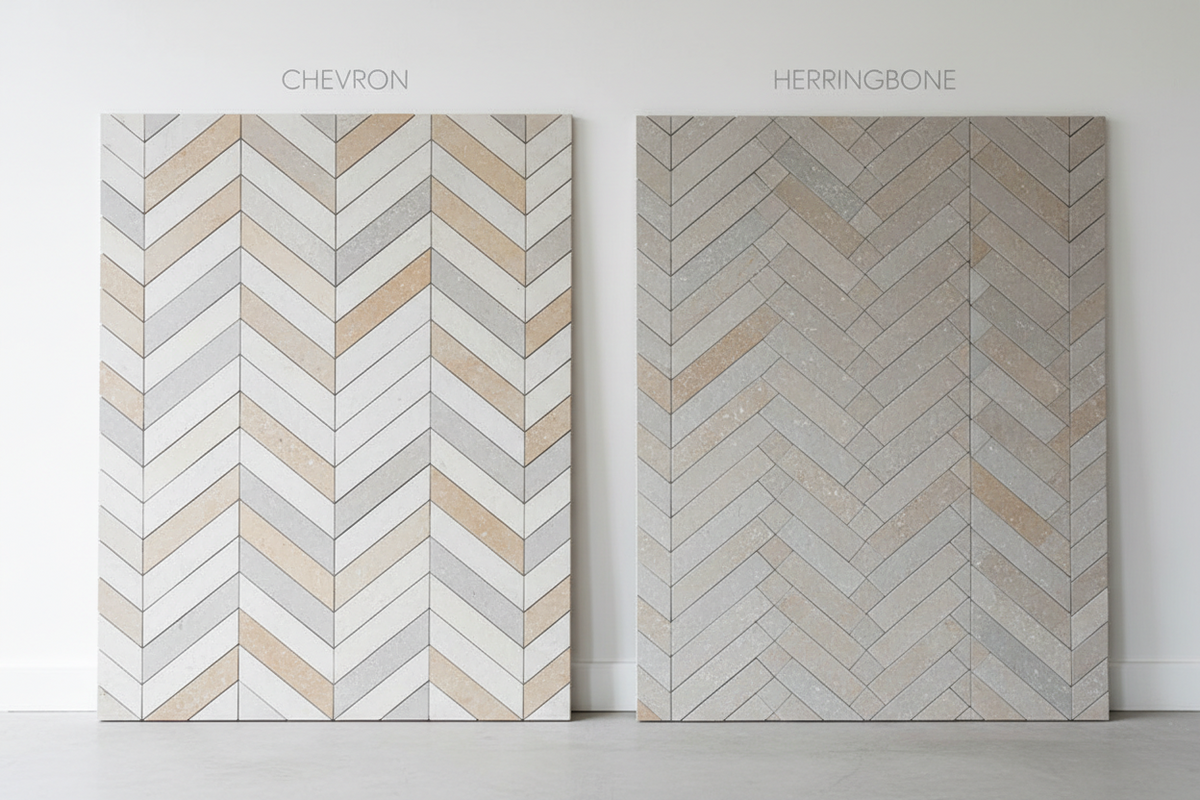
Herringbone uses standard rectangular tiles laid at 90-degree angles in a staggered zigzag — the end of one tile meets the side of another, creating a broken, textured V pattern. Chevron uses tiles with ends cut at a 45-degree angle so they meet point-to-point, forming a continuous, unbroken V or arrowhead shape. Both create a zigzag effect, but herringbone feels classic and textured while chevron feels sharp, modern, and graphic. Herringbone is easier and cheaper to install; chevron requires precise angled cuts and typically costs more in labor.
If you've spent any time looking at tile inspiration online, you've probably used the words "chevron" and "herringbone" interchangeably — and you're not alone. Even seasoned interior designers occasionally mix them up. The two patterns look similar at a glance, both producing a familiar zigzag effect that adds movement, depth, and visual interest to any tiled surface. But they're meaningfully different — in how the tiles are shaped, how they're installed, how much they cost, and the very different visual impressions they create in a finished space.
Getting this distinction right matters for your renovation. Choosing herringbone when you wanted chevron's sharp, continuous lines will leave you disappointed. Specifying chevron when your budget or installer's skills suit herringbone better will cost you more than necessary. And understanding which pattern works best in which room and application — on a shower wall vs. a kitchen backsplash vs. a bathroom floor — can make the difference between a tile job that looks intentional and one that just looks busy.
This guide settles the debate definitively. We'll explain exactly what each pattern is, how each is constructed, compare them head-to-head on every factor that matters — aesthetics, installation, cost, material waste, and room applications — and give you a clear decision framework for choosing the right one for your specific project.
What's in This Guide
- What Is a Herringbone Tile Pattern?
- What Is a Chevron Tile Pattern?
- The Key Difference: One Simple Distinction
- Head-to-Head Comparison
- Aesthetics: Which Looks Better in Which Space?
- Installation: Difficulty, Cost & Material Waste
- Best Applications: Room-by-Room Guide
- Which Tile Materials Work Best with Each Pattern?
- Which Should You Choose? A Clear Decision Guide
- Frequently Asked Questions
- Conclusion
1. What Is a Herringbone Tile Pattern?
The herringbone pattern is one of the oldest decorative arrangements in human design history. Its name comes from its visual resemblance to the skeleton of a herring fish — the diagonal bones branching off a central spine in alternating directions. The pattern dates back to the Roman Empire, where it was used in road construction and mosaic work, and it's been a staple of fine interior design ever since.
In tile terms, herringbone is created using standard rectangular tiles laid in a staggered zigzag arrangement. The tiles themselves are not cut at an angle — they retain their standard rectangular shape with four square corners. Instead, each tile is positioned at a 90-degree angle to its neighbors, with the short end of one tile meeting the long side of the next. This creates a broken, interlocking zigzag pattern that resembles the "V" shape of the fish skeleton it's named after.
The critical characteristic of herringbone: the zigzag is broken. The points of the V don't all meet at the same spot — instead, the pattern creates staggered joints that add texture and visual depth without the sharp precision of a perfectly aligned chevron. This gives herringbone a more organic, layered quality that reads as both classic and contemporary depending on the tile size, material, and color.
▌▐▌▐▌▐
▐▌▐▌▐▌
▌▐▌▐▌▐
Common Herringbone Tile Sizes
Herringbone works with virtually any rectangular tile format. The most popular sizes in American bathroom and kitchen applications include 3"×6" subway tile (the classic combination), 2"×8" thin brick format, 4"×12" for a more modern elongated look, and even large-format 12"×24" for a dramatic, oversized herringbone statement. Many manufacturers sell herringbone pre-mounted on mesh sheets — particularly in smaller formats — which significantly simplifies installation.
2. What Is a Chevron Tile Pattern?
The word "chevron" comes from the Old French word for a roof rafter — and when you look at the pattern, you can see why. A chevron creates a series of continuous, unbroken V shapes or arrowheads pointing in a single direction, creating a strong sense of movement, direction, and graphic precision.
Unlike herringbone, chevron requires tiles that are specifically cut at an angle — typically 45 degrees — at each end. This angled cut allows the tiles to meet point-to-point, creating a seamless, continuous V with no staggered offset. The junction between tiles in a chevron pattern is precise and uninterrupted — the points align perfectly across the entire installation, which is what gives chevron its signature sharp, clean, graphic quality.
Because standard rectangular tiles don't have angled ends, achieving a true chevron pattern requires either: (1) purchasing pre-cut chevron tiles or pre-assembled chevron mosaic sheets, or (2) having standard rectangular tiles custom-cut at an angle during installation — which adds time, skill, and cost. Many tile manufacturers sell chevron-format tiles specifically cut for this pattern, which simplifies the process considerably.
\/\/\/\/
/\/\/\/\
\/\/\/\/
Common Chevron Tile Formats
Chevron tiles are typically available in pre-cut formats — rectangular tiles with angled ends — or as pre-assembled mosaic sheets where the pattern is set on mesh backing. Popular chevron tile formats include pencil-thin strips (creating a tight, dense chevron), standard subway-proportioned chevron cuts, and larger plank chevrons. The pattern is also achieved using diamond tiles, which create the same V-effect with a different construction approach.
3. The Key Difference: One Simple Distinction
If you remember only one thing from this entire guide, make it this:
Herringbone: Standard rectangular tiles. No angled cuts. End of one tile meets the side of the next. Creates a broken zigzag.
Chevron: Tiles cut at an angle (typically 45°). End of one tile meets the point of the next. Creates a continuous, unbroken V-shape.
Everything else — the aesthetic differences, cost differences, installation complexity differences, and application suitability differences — flows from this one fundamental distinction in tile construction and placement.
4. Head-to-Head Comparison
| Feature | Herringbone | Chevron |
|---|---|---|
| Tile shape | Standard rectangle — no cuts needed | Tiles cut at 45° angle at both ends |
| How tiles meet | End of tile meets the side of next tile | Point of tile meets point of next tile |
| Pattern character | Broken, staggered zigzag — organic feel | Continuous V-shape — sharp, graphic lines |
| Visual effect | Classic, textured, layered depth | Modern, bold, directional movement |
| Design style | Traditional through contemporary | Contemporary, geometric, minimalist |
| Installation difficulty | Moderate — DIY friendly | Higher — professional strongly recommended |
| Labor cost | Standard tile labor rate | 10–20% higher than herringbone |
| Material waste | Standard (10–15% overage) | Higher (15–20%+ overage for angled cuts) |
| Tile availability | Any rectangular tile works | Requires pre-cut chevron tiles or custom cutting |
| Error visibility | Minor misalignments less noticeable | Even small errors highly visible |
| Space effect | Adds texture and depth | Draws eye, adds strong directionality |
| Best for | Versatile — works almost everywhere | Feature walls, backsplashes, statement floors |
5. Aesthetics: Which Looks Better in Which Space?
Herringbone Aesthetic
- Warm, layered, organic quality
- Adds texture without overwhelming
- Works equally well in traditional and modern settings
- Less visually demanding — supports other design elements
- Creates depth without sharp graphism
- Timeless — won't feel dated
- Reads differently at small vs large scale — tight with small tiles, dramatic with large planks
Chevron Aesthetic
- Sharp, graphic, architectural precision
- Strong sense of movement and direction
- Draws the eye — becomes the room's focal point
- More demanding — other elements need to be simpler
- Feels contemporary and bold
- Creates a powerful arrowhead or V-shaped rhythm
- Best in spaces where the tile itself is the design statement
How Each Pattern Affects the Perception of Space
Herringbone on floors makes a room feel richer and more layered without dramatically changing its proportions. The staggered zigzag creates visual interest that doesn't pull the eye aggressively in any single direction — it simply elevates the surface.
Chevron on floors creates a strong directional pull along the axis of the V. Running chevron lengthwise in a hallway or rectangular bathroom makes the space feel longer and draws you through it. Running it widthwise makes a space feel broader. This directional quality is chevron's most powerful design tool — and its most demanding one to use thoughtfully.
Herringbone on walls adds texture and movement to a vertical surface without fighting other design elements. It works beautifully as a full shower wall, kitchen backsplash, or feature wall behind a vanity.
Chevron on walls — particularly vertical chevron — makes ceilings feel higher by drawing the eye upward. It's a popular technique in small bathrooms or powder rooms to create a sense of height. Horizontal chevron on walls creates a bold, graphic statement that works best when the rest of the space is kept deliberately simple.
📊 Design Trend: According to Coverings 2025 — North America's largest tile and stone event — herringbone and chevron patterns both appeared in the top design trends for the year, with herringbone noted as the more versatile and widely applied of the two. Searches for "herringbone tile" consistently outperform "chevron tile" on Google Trends in the US — reflecting herringbone's broader application across more design styles and price points.
6. Installation: Difficulty, Cost & Material Waste
Herringbone Installation
Herringbone is one of the more DIY-accessible patterned tile layouts. Standard rectangular tiles require no special cutting at the edges — they're placed at right angles to each other in a staggered offset. The main installation challenges are planning the layout correctly before starting (to ensure the pattern is centered and balanced), maintaining consistent 90-degree angles throughout, and executing clean cuts at the perimeter where the pattern meets walls.
Most tile installers treat herringbone as a moderate-complexity installation. It typically adds 10–15% to standard labor costs compared to a straight-lay installation of the same tile. Material overage of 10–15% is appropriate for herringbone.
Chevron Installation
Chevron is genuinely more demanding. The angled tile ends must align precisely across the entire installation — and because the continuous V-shape makes any misalignment immediately visible, there is very little margin for error. Even a fraction of a degree off-angle in the cuts compounds over a large installation and creates a visibly crooked result.
If you're using pre-cut chevron tiles or mesh-mounted chevron mosaic sheets, installation difficulty decreases considerably — the angles are already set, and the installer's job is accurate placement and grouting. If you're cutting standard rectangular tiles to create a chevron pattern in the field, professional tile installation is strongly recommended.
Chevron typically adds 15–25% to standard labor costs, and material overage should be planned at 15–20% due to the angled cuts that generate more waste from standard rectangular tiles.
⚠ Planning Note: For chevron specifically, always confirm with your tile supplier whether the tiles you're ordering are pre-cut chevron format or standard rectangular tiles that will require field cutting. This single decision dramatically affects your installation cost and the skill level required from your installer.
Cost Comparison at a Glance
| Cost Factor | Herringbone | Chevron |
|---|---|---|
| Tile material | Any rectangular tile — standard pricing | Pre-cut chevron tiles may cost 10–20% more per sq ft |
| Material overage needed | 10–15% | 15–20%+ |
| Labor premium vs. straight lay | +10–15% | +15–25% |
| DIY viable? | Yes — for experienced DIYers | Only with pre-cut tiles or pre-mounted sheets |
| Overall project cost vs. straight lay | Moderately higher | Notably higher |
7. Best Applications: Room-by-Room Guide
Bathroom Floors
Herringbone is a superb bathroom floor pattern. Its staggered layout creates texture and depth that makes even a simple white subway tile feel like a considered design choice. In smaller bathrooms, herringbone in a light color can make the floor feel larger. In larger master bathrooms, a bold herringbone in contrasting colors or dark stone creates a dramatic focal point underfoot. The herringbone tile pattern guide goes deeper on size, scale, and layout planning for floors.
Chevron on bathroom floors creates a more graphic, directional statement. Running lengthwise, it makes the bathroom feel longer; it works especially well in narrow bathrooms where the directional pull helps the space feel more generous. The angled edges at the perimeter require careful planning and usually more fill cuts — which adds to installation complexity on floors.
Shower Walls
Herringbone is one of the most popular shower wall patterns in contemporary American bathroom design. It works beautifully on a single feature wall of the shower while complementary solid tile covers remaining walls — a classic combination that's enduringly popular. You can see this approach in action throughout our bathroom shower tile guide.
Vertical chevron on shower walls creates an elongating effect — the continuous V draws the eye upward and makes shower enclosures feel taller. This is particularly effective in bathrooms with lower ceilings. Horizontal chevron on a shower feature wall makes a bold geometric statement but requires the surrounding design to be kept deliberately simple to avoid visual chaos.
Kitchen Backsplash
Both patterns work exceptionally well as kitchen backsplashes — this is where most American homeowners first encounter and fall in love with both. Herringbone is the more versatile choice, complementing both traditional Shaker kitchens and contemporary flat-panel cabinet designs. It's one of the most popular backsplash patterns in US kitchen renovation for this reason. Chevron creates a bolder statement — it's best when the kitchen cabinets and countertops are relatively simple, allowing the backsplash pattern to be the room's visual centerpiece.
Entryways and Hallways
Both patterns have a long history in entryway and hallway flooring. Chevron running lengthwise in a hallway is particularly effective — the directional arrow of the pattern draws you down the corridor and makes the space feel both longer and more intentional. Herringbone in entryways creates a welcoming first impression with rich texture that sets an elevated tone for the home without demanding too much attention from other design elements.
Feature Walls (Living Room, Bedroom)
Both patterns can elevate a feature wall dramatically. Herringbone on a fireplace surround or behind a bed headboard creates a warm, layered backdrop. Chevron on a feature wall — particularly in a large-format tile — makes a bold architectural statement. For stone feature walls specifically, herringbone tends to suit natural stone better because the broken pattern complements stone's organic variation; chevron's graphic precision can feel at odds with the organic quality of real stone.
8. Which Tile Materials Work Best with Each Pattern?
Materials That Shine in Herringbone
- Subway tile (ceramic or glass) — the classic combination. 3"×6" subway tile in herringbone is one of the most enduringly popular backsplash and shower wall applications in American homes.
- Natural stone — marble, travertine, and slate in herringbone create a rich, layered look that complements stone's organic variation beautifully.
- Natural pebble tile — herringbone stone mosaic tiles combine the organic beauty of natural pebble with the classic herringbone layout for a distinctive, spa-inspired result.
- Wood-look porcelain planks — herringbone in wood-look tile is one of the most popular flooring layouts in contemporary American interiors, bringing pattern interest to a material that might otherwise read as plain flooring.
- Glass tile — herringbone in glass catches and reflects light in multiple directions, creating a luminous, jewel-like quality on backsplashes and shower walls.
Materials That Shine in Chevron
- Porcelain — chevron's sharp lines suit the precise, uniform quality of porcelain tile perfectly. The pattern's graphic precision is enhanced by porcelain's consistent color and finish.
- Marble — chevron marble tile, particularly in white or grey tones, creates an elegant, luxury feel on backsplashes and feature walls. The continuous V of chevron showcases marble's veining beautifully.
- Glass mosaic — chevron glass mosaic tiles are a popular backsplash choice, combining the reflectivity and color depth of glass with the dynamic movement of the chevron pattern.
- Pencil tile / thin strips — very thin tile strips in chevron create a dense, intricate pattern with exceptional visual energy. Often used as decorative accents or niche liners.
- Cement / encaustic tile — chevron cement tiles in bold colors or contrasting tones make a powerful, artisan-quality statement on feature walls and powder room floors.
✔ Material Tip: For herringbone, you have total flexibility — any rectangular tile works. For chevron, confirm before purchasing that your chosen tile is available in a pre-cut chevron format or can be cleanly cut at the required angle without chipping or cracking. Some glass tiles, natural stone, and handmade ceramics are difficult to cut at precise angles without specialist tools and expertise.
9. Which Should You Choose? A Clear Decision Guide
Choose Herringbone if you want...
- A classic, timeless pattern that suits almost any design style
- More DIY-friendly installation with standard rectangular tiles
- Lower installation cost and less material waste
- Texture and depth without a dominant graphic statement
- A pattern that complements other strong design elements (bold fixtures, rich cabinetry, natural stone)
- Versatility across multiple rooms and surfaces
- The ability to use any standard rectangular tile you love
Choose Chevron if you want...
- A bold, modern, graphic statement as the room's centerpiece
- Strong directional movement — to elongate a space or draw the eye
- A contemporary or minimalist aesthetic with sharp lines
- A pattern that makes the tile itself the star of the design
- A smaller space to feel taller or longer
- You're happy to use pre-cut chevron tiles or hire a specialist installer
- The budget allows for higher installation and material costs
The Room-by-Room Decision at a Glance
| Location | Better Choice | Why |
|---|---|---|
| Bathroom floor (small) | Either — herringbone slightly easier | Both add pattern without overwhelming a small space |
| Bathroom floor (large) | Herringbone | More forgiving at scale; doesn't overwhelm the space |
| Shower feature wall | Herringbone | Works with the organic quality of shower materials; easier in a constrained space |
| Kitchen backsplash | Both — herringbone for classic, chevron for bold | Herringbone is more versatile; chevron makes a stronger statement |
| Hallway / entryway floor | Chevron (lengthwise) | Directional pull elongates the corridor effectively |
| Powder room floor | Either — chevron for impact | Small high-visibility space ideal for bolder chevron statement |
| Feature wall (living room) | Herringbone for stone; chevron for porcelain/cement | Herringbone suits organic materials; chevron suits precision materials |
| Fireplace surround | Herringbone | Warm, textured quality complements the nature of a fireplace |
10. Frequently Asked Questions
What is the main difference between chevron and herringbone tile?
The fundamental difference is in how the tiles are shaped and how they meet. Herringbone uses standard rectangular tiles laid at 90 degrees — the end of one tile meets the side of the next, creating a broken, staggered zigzag. Chevron uses tiles cut at a 45-degree angle at each end — the angled point of one tile meets the angled point of the next, creating a continuous, unbroken V-shape. The result is two distinct visual effects: herringbone is organic and textured; chevron is sharp, graphic, and directional.
Is herringbone or chevron more popular in 2026?
Herringbone is more widely used across American homes in 2026, primarily because it works with any rectangular tile, suits more design styles, and is more affordable and DIY-accessible to install. Chevron remains popular as a bold statement choice — particularly for kitchen backsplashes, powder rooms, and entryway floors — but its installation complexity and higher cost make it a more deliberate, targeted choice rather than a versatile standard. Both appear consistently in US design trends from Coverings 2025 and NKBA surveys.
Is chevron harder to install than herringbone?
Yes — consistently. Herringbone uses standard rectangular tiles with no angled cuts required, making it more accessible for experienced DIYers and faster for professional installers. Chevron requires tiles with precisely angled ends that must align perfectly across the entire installation — even minor errors are immediately visible. Using pre-cut chevron tiles or pre-assembled chevron mosaic sheets reduces the difficulty, but professional installation is still recommended for floor and large-format wall applications.
Can I use regular subway tile for a chevron pattern?
Not without custom cutting. Standard subway tiles have square ends at 90 degrees — to create a true chevron pattern, those ends must be cut at a 45-degree angle. This requires a wet saw, a skilled operator, and generates significant material waste. The more practical approach is to purchase tiles specifically manufactured in a chevron format, or to use pre-assembled chevron mosaic sheets on mesh backing where the pattern is already set. For a backsplash or small accent area, some experienced DIYers do cut subway tiles to chevron — but for floors or large wall installations, purpose-made chevron tiles are strongly recommended.
Which pattern makes a small bathroom look bigger?
Both can make a small bathroom feel larger, but through different mechanisms. Herringbone in a light color adds visual texture and depth without directing the eye in any particular direction — it makes the surface feel richer without making the room feel smaller. Chevron used vertically or diagonally creates a directional pull that can make low ceilings feel higher and narrow bathrooms feel wider. For the strongest space-expanding effect in a small bathroom, large-format tiles in either pattern with minimal grout lines outperform small-format tiles — fewer visual breaks mean a more continuous, expansive feel.
Does herringbone cost more than a straight tile layout?
Yes — slightly. Herringbone typically adds 10–15% to standard labor costs compared to a straight grid layout, due to the increased complexity of layout planning and the angled cuts at perimeter edges. Material overage of 10–15% above your measured square footage is appropriate. Chevron adds more — typically 15–25% to labor and requires 15–20%+ material overage due to angled cuts generating more waste. For large installations, these cost differences are meaningful and should be factored into your renovation budget.
Can you combine herringbone and chevron in the same space?
Yes — when done intentionally, the two patterns can complement each other beautifully. A common approach: herringbone on the main bathroom walls or floor for texture and warmth, with a chevron accent strip or niche lining as a precise geometric contrast. The key is giving each pattern enough space to read distinctly — mixing them too closely together creates visual confusion rather than intentional contrast. Keeping the same tile material and color across both patterns helps unify the design.
Which pattern is better for a kitchen backsplash?
Both work beautifully on kitchen backsplashes — the choice depends on your kitchen's design direction and how bold you want the backsplash to be. Herringbone suits kitchens where the backsplash should add texture and warmth without competing with cabinetry, hardware, or countertops — it's the more versatile background choice. Chevron suits kitchens where the backsplash is intended to be the room's design centerpiece — typically paired with simpler, flatter cabinet fronts and neutral countertops that let the pattern breathe. Our guide to choosing kitchen backsplash wall tiles explores this decision in more depth.
11. Conclusion: Two Great Patterns, One Clear Framework for Choosing
Herringbone and chevron are both extraordinary tile patterns — each with centuries of design history, enduring popularity, and the ability to transform an ordinary tiled surface into something genuinely memorable. The confusion between them is understandable, but now that you know the fundamental distinction — herringbone's broken, staggered zigzag vs. chevron's continuous, precise V-shape — the choice between them becomes much clearer.
If you want a pattern that works everywhere, complements almost any design style, is more budget-friendly to install, and brings organic warmth and texture to floors, walls, and backsplashes across your home — herringbone is the more versatile and forgiving choice. If you want a bold, architectural, directional statement that makes the tile the star of the room — and you're prepared for the additional cost and precision that requires — chevron delivers something herringbone cannot match.
Most successful bathroom and kitchen renovations use one pattern as the primary surface treatment and use the other — if at all — as a deliberate accent or contrast. The combination of herringbone on shower walls with a chevron accent niche lining, or chevron on a kitchen backsplash with herringbone on the floor, creates the layered, considered quality that makes a renovated space feel truly designed.
Whatever pattern you choose, the tile material underneath it matters just as much as the layout. At Pebble Tile Shop, we carry natural stone herringbone mosaic tiles, stone mosaic sheets that suit both layouts beautifully, and pebble stone mosaics that bring genuine organic character to any pattern you choose. We offer sample ordering so you can see and feel the material before committing — because how a tile looks in a photograph and how it looks on your bathroom wall are genuinely different things.
Explore our collection at pebbletileshop.com and request samples for your next project.


Leave a comment
This site is protected by hCaptcha and the hCaptcha Privacy Policy and Terms of Service apply.