
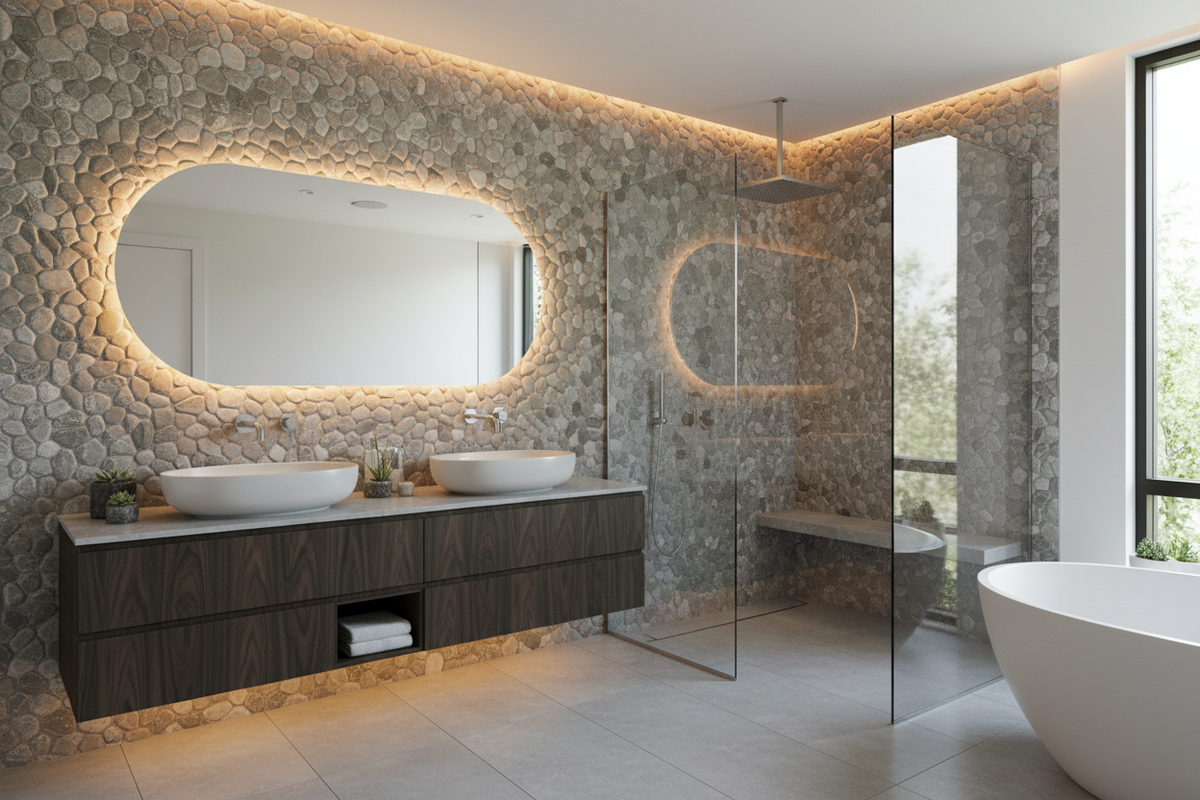
A stone wall in the bathroom sounds like a dream — and done right, it absolutely is. Real stone brings something into a bathroom that no manufactured tile can touch: organic beauty, tactile authenticity, and a quiet sense of permanence that makes the most mundane morning routine feel like a luxury. There's a reason homeowners who take the plunge rarely regret it. Walk into a bathroom with a real stone wall and you feel the difference immediately.
But here's the part that doesn't make the beautiful magazine spreads: stone bathroom walls are also one of the most mistake-prone home renovations an American homeowner can undertake. The mistakes aren't always visible at first — sometimes not for months or years. By the time water damage appears in an adjacent wall, or grout starts blackening along the base of a shower, or tiles begin loosening from a wall that was never properly waterproofed, the cost to fix the problem has mushroomed far beyond what the original installation cost.
This guide covers both sides of the story honestly. The genuine pros that make stone bathroom walls worth the investment. The real cons you deserve to know before you commit. And — most importantly — the ten most common and costly mistakes homeowners make with stone bathroom walls, along with exactly how to avoid every single one of them.
If you're seriously considering a stone wall in your bathroom, this is the guide to read before you do anything else.
In This Guide
- Why Homeowners Choose Stone Bathroom Walls
- Best Stone Types for Bathroom Walls
- The Real Pros of a Stone Bathroom Wall
- The Honest Cons of a Stone Bathroom Wall
- 10 Costly Mistakes Homeowners Make (And How to Avoid Them)
- Special Section: Stone Walls in the Shower
- Design Ideas for Stone Bathroom Walls in 2026
- What Does a Stone Bathroom Wall Really Cost?
- DIY vs. Professional Installation
- Maintaining Your Stone Bathroom Wall
- Frequently Asked Questions
- Conclusion
1. Why Homeowners Choose Stone Bathroom Walls
The bathroom has undergone a profound cultural transformation in American homes over the past decade. It's no longer purely functional — a room you pass through. It's a sanctuary. A space for decompression, self-care, and daily rituals that set the tone for everything that follows. The National Kitchen & Bath Association's (NKBA) 2024 Design Trends Report found that 68% of American bathroom remodelers said their primary goal was creating a "spa-like" atmosphere — and natural stone was ranked the number-one material choice for achieving that feeling.
That cultural shift explains a great deal about why stone bathroom walls have moved from luxury-home exclusives to aspirational projects for everyday American homeowners. But the reasons go deeper than pure aesthetics.
📊 Market Data: According to the Joint Center for Housing Studies at Harvard University, American homeowners spent over $420 billion on home improvements in 2023 — a record high — with bathroom renovations among the top-performing categories by both spending and ROI. Premium material upgrades, including natural stone, captured a growing share of renovation budgets as homeowners prioritized long-term value over short-term savings.
Stone bathroom walls appeal to homeowners for a simple reason that professionals in the space will confirm: when you tile a bathroom in natural stone and someone walks in, they know immediately that something is different. Not just different-looking. Different-feeling. The weight of the material, the organic variation, the way natural light moves across a honed marble or travertine surface — it produces a response that's almost physical. That's the draw. And for many homeowners, once they've experienced it, no substitute feels adequate.
2. Best Stone Types for Bathroom Walls
Before we get into pros, cons, and mistakes, let's ground the conversation in the actual material options. Not all natural stone performs equally in the bathroom environment — and choosing the wrong stone for your specific wall application is, in itself, one of the most common mistakes homeowners make.
| Stone Type | Hardness (Mohs) | Porosity | Best Bathroom Use | Maintenance Level |
|---|---|---|---|---|
| Marble | 3–4 | Medium–High | Feature walls, vanity backsplash, shower (honed) | High |
| Travertine | 3–4 | High | Feature walls, shower surround (filled & sealed) | High |
| Quartzite | 7+ | Low | Shower walls, full bathroom walls, wet zones | Low–Medium |
| Slate | 4–5 | Medium | Feature walls, non-shower walls | Medium |
| Limestone | 3–4 | High | Dry walls, feature walls (not showers) | High |
| Granite | 6–7 | Very Low | Any bathroom wall, shower zones | Low |
| Basalt | 6–7 | Low–Medium | Shower walls, modern feature walls | Low–Medium |
| Pebble / River Rock | 6–7 | Low–Medium | Shower walls, accent walls, spa-inspired spaces | Medium |
A quick note on pebble tile for bathroom walls: Natural pebble tiles — river rock mosaics mounted on mesh — are an increasingly popular choice for bathroom walls in 2026, particularly in spa-inspired and organic modern interiors. They bring a tactile, three-dimensional texture to shower walls that flat tile simply can't replicate. Used correctly (flat-sliced pebbles for easier maintenance; round tumbled pebbles for maximum texture), they're one of the most distinctive and beautiful choices available for a stone wall in the bathroom.
3. The Real Pros of a Stone Bathroom Wall
✔ Pro 1: Beauty That No Manufactured Material Can Match
Natural stone produces an aesthetic that is genuinely irreplaceable. The organic variation — marble's unique veining, travertine's warm texture, pebble tile's mosaic depth — means your bathroom wall is literally one-of-a-kind. No two quarried stones are identical. High-definition porcelain does a convincing impression at a glance, but in person, in a space you live in every day, the difference is unmistakable. Real stone has visual depth. It breathes. It catches light differently at 7am than it does at 7pm. That's not something technology can fully replicate.
✔ Pro 2: Longevity That Outlasts the Building
With correct installation and basic maintenance, natural stone bathroom walls last 50 to 100+ years. Ancient stone walls from Roman-era bath complexes are still structurally sound. In the context of a modern American bathroom, that level of durability means your stone wall will almost certainly outlive your mortgage — and your need to ever renovate that surface again. That long view changes the cost calculation dramatically.
✔ Pro 3: Measurable Increase in Home Value
Natural stone is a recognized premium feature in American residential real estate. A 2024 Zillow market analysis found that bathrooms featuring natural stone were associated with 3–5% higher listing prices in comparable markets, and listings describing "natural stone" received 18% more buyer engagement than comparable homes with standard tile. Real estate agents consistently cite stone bathroom walls — particularly marble shower surrounds and full stone feature walls — as luxury features that accelerate sale timelines and support premium pricing.
✔ Pro 4: Natural Heat Retention for Greater Comfort
Natural stone has excellent heat retention properties. It absorbs warmth from shower steam and radiated heat, keeping your bathroom feeling warmer and more comfortable — particularly in colder months. Stone is also one of the best-performing materials for radiant heating systems, which are a growing feature in American master bathroom renovations. Once the stone is warm, it stays warm longer than ceramic or porcelain equivalents.
✔ Pro 5: Eco-Friendly, VOC-Free, and Hypoallergenic
Unlike many manufactured building materials, natural stone contains no synthetic chemicals, releases no VOCs into your home's air, and requires no energy-intensive manufacturing process. For homeowners focused on indoor air quality — particularly important in bathrooms where ventilation can be limited — natural stone is one of the most health-conscious wall material choices available. Its non-porous variants (granite, quartzite, basalt) also resist mold and mildew growth when properly sealed.
✔ Pro 6: Timeless Appeal That Transcends Trends
Bathroom design trends have a shelf life. All-white subway tile looked fresh in 2010 and dated by 2020. Natural stone has been prized in domestic interiors since antiquity — and it will be in 2040. Marble and travertine bathroom walls don't become dated because they were never "trendy" in the first place. They exist outside the trend cycle. That's a significant advantage when you're making a renovation investment you'll live with for the next 15–30 years.
4. The Honest Cons of a Stone Bathroom Wall
✖ Con 1: Higher Upfront Cost
Stone bathroom walls cost significantly more than ceramic or porcelain alternatives — both in materials and installation. Budget-grade ceramic tile can be sourced for $1–3 per square foot. Natural stone starts at $3–8 for travertine and slate, and runs $15–40+ for premium marble and quartzite. When you add professional installation ($8–15 per sq ft for stone), waterproofing membrane, sealer, and setting materials, a full stone bathroom wall project can run 3–5x the cost of an equivalent ceramic tile installation.
✖ Con 2: Porosity Demands Consistent Sealing
Most natural stone is porous. Without proper sealing, bathroom stone walls absorb moisture, soap, and oils — leading to staining, mold in grout joints, and potentially water migration behind the tile. This isn't optional maintenance. It's a baseline requirement for any natural stone bathroom wall, particularly in wet zones like shower surrounds. For homeowners who don't want to commit to annual sealing, a denser stone (quartzite, granite, basalt) significantly reduces — though doesn't eliminate — this demand.
✖ Con 3: Ongoing Maintenance That's Different From Regular Tile
Stone bathroom walls require pH-neutral cleaning products only. Vinegar, lemon juice, bleach, ammonia, and most standard bathroom sprays will etch, discolor, or degrade natural stone over time — even with occasional use. If your household cleaning routine involves reaching for whatever's under the sink, stone will punish that habit. The maintenance is genuinely manageable for most homeowners, but it requires awareness and some adjustment of habits.
✖ Con 4: Installation Complexity Requires Skilled Professionals
Natural stone wall installation in wet areas is not a beginner DIY project. The waterproofing requirements, correct thinset specification (white, polymer-modified — not grey), proper sealing sequence, and stone-specific handling demands require an installer who has worked with natural stone before. A skilled ceramic tile installer and a skilled natural stone installer are not the same thing, and assuming they are is a common and expensive mistake.
✖ Con 5: Repair and Matching Challenges
If a tile cracks or a section of stone needs to be replaced years after installation, matching the original stone from a different production lot is extremely difficult — sometimes impossible. Natural stone's organic variation means every quarry run is different. This is why ordering 15–20% overage and storing leftover tiles is so important. The homeowners who ignore this advice are the ones paying premium prices years later to source stone that "sort of matches" a cracked section of their shower wall.
5. 10 Costly Mistakes Homeowners Make with Stone Bathroom Walls (And How to Avoid Every One)
This is the section that can save you thousands of dollars and months of headaches. These mistakes aren't hypothetical — they're what renovation professionals and tile specialists see on rescue jobs week after week across America. Every single one of them is avoidable.
Skipping the Waterproof Membrane
This is the single most expensive mistake in stone bathroom wall installation — and it happens more often than any professional wants to admit. Many homeowners (and some less experienced contractors) believe that tile and grout create a waterproof barrier. They do not. Water passes through grout joints over time. Without a proper waterproof membrane behind the tile, moisture migrates into the wall framing, causing rot, mold, and structural damage that can remain hidden for months or years.
A real-world case from a licensed renovation firm in Indianapolis: a homeowner had a shower retiled by a handyman-style operation. Two years later, a soft spot appeared in the floor outside the shower and grout was darkening at the base. When opened up, there was no waterproofing membrane — tile had been set directly over cement board. Behind the walls, moisture had been migrating into the framing for two years. The original shower cost $6,500. The remediation cost $47,000.
Installing Over Inadequate Substrate
Standard drywall — even moisture-resistant "greenboard" — is not an appropriate substrate for natural stone wall tile in wet areas. Regular drywall absorbs water and deteriorates behind tile. Greenboard resists surface moisture but is not waterproof and is not rated for direct water exposure in shower zones. Stone tile adds significant weight that unprepared substrates may not adequately support. Inadequate substrate preparation is responsible for a large percentage of tile failures in bathroom renovations.
Using the Wrong Thinset Mortar
This mistake catches homeowners off guard because it seems minor. Using grey thinset mortar under white or light-colored natural stone — marble, quartzite, travertine — causes the grey to telegraph visibly through the stone, creating permanent blotchy discoloration. Additionally, using non-polymer-modified thinset or an organic mastic adhesive in wet wall areas can result in adhesive failure over time, especially with heavier stone formats.
Skipping Pre-Grouting Stone Sealer
Ask any stone tile professional what the most frequently reported installation regret is, and pre-sealing will come up immediately. When porous natural stone is grouted without first sealing the stone surface, grout pigment penetrates the stone and creates permanent "grout haze" — a discoloration that cannot be fully removed without professional stone restoration, and sometimes not even then. This is particularly devastating on marble and travertine, where the contrast between the stone and the grout stain is stark and obvious.
Choosing the Wrong Stone for the Application
Not all natural stone performs equally in the bathroom environment. Homeowners regularly fall in love with the look of a stone without checking whether it's appropriate for where they're installing it. Highly porous limestones and unfinished travertines used on shower walls without adequate sealing maintenance develop serious mold and staining problems. Polished marble used on shower floors is a slip hazard. Soft stones with poor water resistance used on vanity backsplashes get etched by everyday toiletry splashes within months.
Ignoring Corner and Penetration Sealing
Even perfectly waterproofed stone bathroom walls fail if corners and penetrations are not properly sealed. Corners — where two tiled planes meet — are among the highest-risk areas for water ingress. They're subject to movement from thermal expansion and structural settlement that cracks rigid grout over time. Unsealed corners behind a shower are a direct pathway for water to enter the wall cavity. The same applies to all penetrations: showerhead fittings, faucet holes, niche edges, and trim pieces.
Not Back-Buttering Large Stone Tiles
When natural stone tiles are installed without "back-buttering" — applying a skim coat of thinset to the back of each tile in addition to applying thinset to the wall — voids form under the stone. These hollow spots amplify stress, cause tiles to sound hollow when tapped, create pathways for water migration, and increase the risk of tile cracking and adhesion failure over time. Industry standards require 95% mortar coverage under stone tiles in wet areas. Without back-buttering, this coverage level is difficult to achieve consistently.
Using Acid-Based Cleaners on Natural Stone
This mistake doesn't happen during installation — it happens six months to two years later, when a homeowner reaches for whatever cleaning product is at hand and applies it to their natural stone bathroom wall. Vinegar, lemon-based cleaners, citrus degreasers, bleach, ammonia, and most standard bathroom tile sprays are either too acidic or too alkaline for natural stone. They chemically etch the surface, stripping the polish or honed finish and leaving permanent dull marks — especially visible on marble. "Natural" or eco-friendly cleaners are not automatically safe; many use citric acid which is equally damaging.
Ordering Too Little Tile (And Not Saving Overage)
Two related mistakes that compound each other. Ordering the exact square footage of stone with no overage buffer means any cutting errors, damaged tiles during installation, or material waste leaves the project short — and reordering from the same production lot may not be possible if it sold out. Worse, homeowners who do order enough but don't save leftover tiles have no way to match a cracked or damaged tile years later, since natural stone production runs are unique and a replacement order from a later lot will never be an exact match.
Hiring Based on Price Rather Than Stone Experience
Natural stone installation and standard ceramic tile installation are not the same trade. The waterproofing requirements, thinset specifications, sealing sequence, stone handling, and grouting techniques differ in ways that matter enormously to the long-term outcome. A highly skilled ceramic tile installer who has never worked with marble or quartzite will make predictable mistakes on a natural stone project. The industry is full of stories — like the $47,000 waterproofing remediation mentioned earlier — that began with someone choosing the lowest bid without asking the right questions.
Important Reminder: Many of these mistakes are invisible at installation time. A shower that looks perfect on day one can develop catastrophic water damage within two years if waterproofing was skipped or corners weren't sealed. The consequences of stone bathroom wall mistakes are often delayed — and that delay makes them more expensive when they finally surface.
6. Special Section: Stone Walls in the Shower
The shower is the most technically demanding application for a stone wall in the bathroom — and the most rewarding when done right. A stone-clad shower is transformative. It's also the application where the mistakes above are most likely to occur and most costly when they do.
What Makes Shower Stone Walls Different
Shower walls face conditions no other bathroom wall does: daily water exposure, temperature cycling between cold and hot, steam humidity, soap and shampoo chemistry, and the physical impact of water stream pressure. Every one of these factors tests the installation quality — the waterproofing, the adhesion, the sealing, the grout integrity. A dry feature wall forgives minor installation imperfections. A shower wall does not.
Stone Tile vs. Pebble Tile for Shower Walls
For shower walls specifically, flat-format stone tile and natural pebble tile each have their advocates — and both work beautifully when properly installed.
| Feature | Flat Stone Tile | Natural Pebble Tile |
|---|---|---|
| Aesthetic impact | Elegant, refined, spa-hotel quality | Organic, textural, nature-immersive |
| Grout lines | Fewer, larger joints (easier to clean) | More joints (require consistent maintenance) |
| Installation difficulty | Moderate–High | Moderate (mesh backing simplifies layout) |
| Tactile quality | Smooth, sleek | Textured, massage-like underfoot |
| Sealing requirement | Annual (varies by stone) | Annual (pre-grout + post-installation) |
| Slip resistance (wall) | Depends on finish (avoid polished) | Excellent on floors; good on walls |
For shower walls specifically, natural pebble tile on the feature wall combined with a complementary flat stone tile on the remaining walls creates a layered, spa-inspired look that's among the most popular bathroom aesthetics in 2026. The contrast between textures and the organic warmth of river pebble against clean stone tile is genuinely beautiful — and it's a look that photographs well but is even better to experience in person.
The Non-Negotiables for Stone Shower Walls
- Proper waterproof membrane behind ALL wet surfaces — not just the shower floor
- White polymer-modified thinset (never grey, never mastic)
- Back-buttering of every tile for 95%+ mortar coverage
- Pre-grouting stone sealer application
- Silicone caulk (not grout) in all inside corners and at floor-wall transitions
- All penetrations (showerhead, faucet, niche edges) sealed with waterproof trim or sealant
- Final penetrating sealer coat over stone and grout before first use
- Annual re-sealing on a consistent schedule
7. Design Ideas for Stone Bathroom Walls in 2026
Beyond the technical requirements, the creative possibilities of stone bathroom walls in 2026 are genuinely exciting. Here's where the design conversation is heading.
Full Immersion: The "Mineral Drenching" Approach
One of the dominant design movements identified by Coverings 2025 — the leading tile and stone industry event in North America — is "mineral drenching": enveloping an entire bathroom in a single stone material, floor to ceiling, on every wall, including shower niches. The effect is immersive and extraordinary. All-travertine bathrooms, all-marble shower rooms, and slate-walled wet rooms create an environment that feels genuinely cave-like and restorative in a way no accent tile can achieve.
Warm Neutrals Replacing Cold Whites
The cool, clinical white marble bathroom that defined the 2010s is being displaced in 2026 by warmer palettes. Honey-toned travertine, creamy limestone, golden quartzite, and warm-veined marbles in beige and tan ranges dominate the new luxury bathroom aesthetic. Stone Tile Depot's 2025 trend analysis confirmed the palette is "warming significantly" — toward earthy, comforting tones that feel permanently inviting rather than temporarily stylish.
Pebble Tile Accent Walls and Shower Features
Using natural pebble tile as a feature wall within the shower — with complementary flat stone on remaining walls — continues to grow in popularity for spa-inspired master bathrooms. The tactile contrast between smooth stone and textured river rock creates a genuinely immersive bathing environment. Mixed-color river pebble against white marble walls; black basalt flat pebble against warm travertine; white oval pebble against dark slate — the combinations reward experimentation.
Textured and 3D Stone Surfaces
Flat, polished stone walls are giving ground to more tactile, three-dimensional approaches: fluted stone panels, rough split-face slate, brushed travertine with deeply expressed natural voids, and stacked stone veneer in irregular courses. These textured surfaces create shadow play and architectural depth impossible with flat tile — particularly effective on the wall behind a freestanding tub or the feature wall of an open-plan bathroom.
Large-Format Stone Panels: Fewer Grout Lines, More Impact
The shift to large-format tiles — 24"x48" and above — is fully expressing itself in bathroom stone walls. Stone panels at these scales create near-seamless surfaces that maximize the visual impact of each stone's natural patterning. Fewer grout lines mean cleaner aesthetics, easier maintenance, and a more expansive feel. This approach requires precise installation and a substrate that's perfectly flat — any unevenness becomes dramatically visible at large format — but the results justify the precision.
8. What Does a Stone Bathroom Wall Really Cost?
Here's the honest breakdown — material cost, installation labor, and all the additional materials that add up between the tile purchase and the finished wall.
| Project Type | Approx. Area | Material (Stone Only) | All-In Estimate |
|---|---|---|---|
| Shower feature wall (pebble or stone tile) | ~15 sq ft | $60–$450 | $400–$1,200 |
| Full shower surround (3 walls) | ~60 sq ft | $240–$2,400 | $1,500–$6,000 |
| Bathroom feature wall | ~40 sq ft | $160–$1,600 | $800–$3,500 |
| Full bathroom wall tile | ~120 sq ft | $480–$4,800 | $2,500–$9,000 |
| Vanity backsplash only | ~15 sq ft | $45–$600 | $300–$1,500 |
📊 Cost Reality Check: According to HomeAdvisor's 2025 True Cost Guide, the average natural stone tile installation project in America costs $1,969 all-in, with a range of $450 to $6,500 for residential applications. Luxury full-bathroom stone installations with premium materials and complex patterns can reach $15,000–$30,000. Always budget an additional 10–15% contingency above your contractor's quote for unexpected substrate issues, additional waterproofing requirements, or material adjustments discovered during installation.
9. DIY vs. Professional Installation for Stone Bathroom Walls
Let's be direct about this, because too many homeowners make expensive decisions based on overconfidence.
When DIY Is Reasonable
If you have genuine intermediate-to-advanced tile installation experience, the right tools, and the project is a dry application — a stone feature wall in a living room, a fireplace surround, a sheltered outdoor wall — DIY stone tile installation is achievable. The stakes are lower on dry walls: no waterproofing membrane, no risk of structural water damage, more forgiving of minor errors.
When Professional Installation Is Non-Negotiable
Shower walls. Full bathroom walls with regular moisture exposure. Any wet zone. For these applications, professional installation by an installer with documented natural stone experience is the only responsible path. The case studies from real renovation professionals are unambiguous: the most expensive bathroom repairs they encounter — the ones that routinely cost $40,000–$150,000 to remediate — almost always trace back to inadequate waterproofing done by inexperienced DIYers or low-bid contractors who cut corners on the steps that aren't visible when the job is finished.
Real Cost of Cutting Corners: One licensed renovation firm documented a case where a homeowner's stone shower installed for $6,500 by an under-qualified contractor required $47,000 in remediation two years later due to absent waterproofing. Another saw a $38,000 DIY bathroom renovation require $140,000 to correct. Professional installation of a stone shower wall typically costs $1,500–$4,000 in labor. The insurance value of doing it correctly is immeasurable.
10. Maintaining Your Stone Bathroom Wall
The Weekly Routine (5 Minutes)
Wipe stone surfaces with a squeegee or soft cloth after each shower use to remove excess moisture. This single habit dramatically reduces soap scum buildup and extends the life of your sealer. Once a week, spray with a pH-neutral stone cleaner and wipe with a soft microfiber cloth. That's it. This basic routine keeps natural stone bathroom walls looking exceptional with minimal time investment.
Monthly Grout Attention
Once a month, run a soft grout brush over all grout joints with a stone-safe grout cleaner. This prevents mold and mildew from establishing a foothold — especially around the shower drain and at floor-wall transitions where moisture lingers longest.
Annual Resealing
Perform the water bead test once a year: drop water on the stone surface. If it beads up, your sealer is holding. If it absorbs and darkens the stone, reseal. The process takes about an hour for an average bathroom, costs under $30 in materials, and protects your entire stone investment for another year. Never skip this step in a wet zone.
Products to Never Use on Natural Stone
- Vinegar or lemon-based cleaners — acidic, causes permanent etching
- Bleach or chlorine-based products — discolors grout and degrades stone surface
- Ammonia-based cleaners (including many glass cleaners) — too alkaline
- Standard multi-surface bathroom sprays — almost always too acidic for stone
- Abrasive scrubbing pads or powders — scratches honed and polished surfaces permanently
- Steam cleaners — heat degrades sealer over time
- "Natural" or eco cleaners with citric acid — equally etching as conventional acid cleaners
11. Frequently Asked Questions
Can I put a stone wall in my bathroom myself?
On dry walls — a feature wall, fireplace surround, or sheltered outdoor wall — homeowners with genuine intermediate tile experience can achieve good results. For shower walls and wet bathroom applications, professional installation by an experienced stone tile specialist is strongly recommended. The waterproofing sequence, thinset specifications, and stone-specific handling skills required in wet zones make amateur errors both common and extremely expensive to correct. The most costly bathroom repairs professionals encounter almost always trace back to DIY or under-qualified contractor work in wet zones.
Is natural stone too high-maintenance for a bathroom?
It depends on the stone and the application. Dense stones like quartzite, granite, and basalt require minimal maintenance — annual sealing and weekly pH-neutral cleaning. More porous stones like marble and travertine demand more consistent sealing and care but are entirely manageable for most homeowners willing to establish a routine. The key is matching stone porosity to your maintenance willingness and lifestyle. If you want natural stone beauty with the lowest possible maintenance, quartzite is the material to know.
What is the best natural stone for a bathroom feature wall?
For a dry feature wall (behind a vanity, behind a freestanding tub, or as an accent wall), virtually any natural stone works beautifully — marble, travertine, limestone, quartzite, slate. The constraints are lighter on dry walls than on shower walls. For a shower feature wall, quartzite, granite, basalt, or properly sealed marble and travertine are the most reliable performers. Natural pebble tile is an excellent choice for shower feature walls — its organic texture creates a distinctive, spa-like quality that flat tile can't replicate.
How do I know if my stone bathroom wall has a waterproofing problem?
Early warning signs include: grout darkening at the base of the shower walls or floor-wall transitions; a soft spot in flooring adjacent to the shower; musty odor in the bathroom that doesn't resolve with ventilation; paint peeling on an adjacent wall; tiles beginning to sound hollow when tapped; or grout cracking at inside corners (particularly if silicone caulk was not used). Any of these signs warrant immediate professional assessment. Delayed investigation significantly increases the damage and the remediation cost.
How often does a stone bathroom wall need to be sealed?
For shower walls and other wet applications: annually, or every 18 months with a premium penetrating impregnating sealer. For dry feature walls: every 2–3 years. Perform the water bead test annually — drop water on the stone surface and observe. If it beads and sits, the seal is holding. If it absorbs within 2–3 minutes and darkens the stone, resealing is needed. Higher-density stones (quartzite, granite, basalt) seal less frequently than porous stones (travertine, marble, limestone).
What's the difference between grout and caulk for stone bathroom walls — and where should each be used?
Grout is used to fill the joints between tiles on flat surfaces. Caulk — specifically flexible, mildew-resistant silicone — is used at all inside corners, at floor-wall transitions, and around all penetrations (plumbing fixtures, showerhead, faucet holes). Grout in corners cracks over time due to movement from thermal expansion and structural settlement, creating water ingress pathways. This is one of the most common causes of behind-wall moisture damage in stone bathrooms. If your installer wants to grout the inside corners of your shower, that's a red flag.
Can pebble tile be used on bathroom walls?
Absolutely — and it creates a beautiful, distinctive effect, particularly on shower walls and feature walls. Flat-sliced pebble tiles offer the organic look of river rock with shallower grout joints that are easier to clean than round tumbled stones. Round tumbled pebble tile creates a more immersive, massage-like texture that's especially popular in spa-inspired shower designs. Both work well on walls when properly installed with appropriate waterproofing, sealed before grouting, and maintained with annual re-sealing. Explore our full collection at Pebble Tile Shop.
Will a stone bathroom wall increase my home's value?
Yes — meaningfully so in most American markets. Natural stone is a recognized premium feature in residential real estate, particularly in bathrooms. A 2024 Zillow analysis found natural stone bathrooms associated with 3–5% higher listing prices in comparable markets. Real estate agents consistently cite stone shower walls and feature walls as luxury features that attract buyer attention and support premium pricing. The effect is most pronounced in mid-to-upper market homes; in entry-level markets, the enjoyment value during ownership may outweigh the direct financial ROI at resale.
12. Conclusion: Done Right, a Stone Wall in the Bathroom Is One of the Best Investments You Can Make
A stone wall in the bathroom is one of those renovation choices that people rarely regret — as long as they go into it with clear eyes about what it requires. The beauty is real. The longevity is real. The home value impact is real. And so are the requirements: the right stone for the right application, a qualified installer, proper waterproofing, correct sealing, and an honest maintenance commitment.
The ten mistakes covered in this guide aren't cautionary tales from extreme cases. They're the most common errors that tile and stone professionals encounter and repair every week across America. Every one of them is avoidable. And avoiding them is simply a matter of knowing what to ask, what to require, and what to never skip — regardless of what a contractor, a budget, or a timeline is pressuring you toward.
If you walk away from this guide with one thing, let it be this: the cost of doing a stone bathroom wall correctly is a fraction of the cost of doing it wrong and having to fix it. The $47,000 remediation job that started as a $6,500 stone shower didn't have to happen. It could have been avoided for a few hundred dollars of waterproofing membrane and a contractor who knew what they were doing. That gap — between what corners get cut and what they cost — is the most important thing to understand before your project begins.
Now — when you're ready to find the stone itself, we want to be the place you come to.
At Pebble Tile Shop, we've built our business around one thing: helping American homeowners find the finest natural stone tile for their specific project — with the honest, knowledgeable guidance that makes the difference between a bathroom you love and a bathroom you have to fix. We're specialists, not a big-box retailer. We know our stones intimately, and we care about your outcome as much as you do.
Our collection spans natural river pebble mosaics, flat-sliced stone sheets, tumbled natural stone, and premium curated collections designed specifically for bathroom walls, shower surrounds, and outdoor spaces. Every product is vetted for quality, mesh backing integrity, consistent sizing, and appropriate application performance. We offer sample ordering — because no one should commit to a full stone purchase without holding the actual material in their hands under their actual room lighting. And our team is genuinely available to help you navigate stone type, finish, sealing products, and installation requirements before you buy a single tile.
Your stone bathroom wall is closer than you think — and it will be extraordinary for decades to come when built on the right foundation.
Start with the stone that's right for your home. Explore our full collection — and get free samples before you commit.

Leave a comment
This site is protected by hCaptcha and the hCaptcha Privacy Policy and Terms of Service apply.